If you’re shopping for a new air conditioner, you’ve probably come across the term SEER2. But what does that number actually mean, and what SEER2 rating should you be looking for in East Texas?
SEER2 is the current energy-efficiency rating used for air conditioners and heat pumps. It replaced the old SEER system in 2023, with stricter testing meant to give you a better idea of how HVAC equipment will actually perform once it’s installed in your home.
Knowing what those numbers mean can make it a lot easier to compare your options and find a system that fits your home, your budget and our long cooling season here in East Texas.
What is SEER and What is SEER2?
SEER stands for Seasonal Energy Efficiency Ratio. It compares how much cooling an air conditioner or heat pump provides during a typical cooling season to how much electricity it uses.
Think of it like the gas mileage rating on a vehicle. The higher the SEER rating, the more cooling you’re getting for the energy being used.
SEER2 measures basically the same thing, but the way equipment is tested has changed. The newer test puts HVAC systems under greater external static pressure, which is closer to the resistance they deal with once they’re hooked up to the ductwork in an actual home.
So, while you’ll still see both numbers out there, SEER and SEER2 aren’t interchangeable. If you’re shopping for a new system today, SEER2 is the number to pay attention to.
Why Did the Rating Change?
In 2023, the U.S. Department of Energy introduced updated efficiency standards and a new testing procedure known as the M1 test.
One of the biggest changes was increasing the external static pressure used during testing. In simple terms, the old test didn’t put as much resistance on the system as it might encounter while pushing air through the ductwork of an actual home. The M1 procedure was designed to create testing conditions that more closely reflect real-world HVAC performance.
That means SEER2 gives homeowners a more realistic way to compare the efficiency of newer air conditioners and heat pumps.
SEER2 Comparison Chart
So, what counts as a good SEER2 rating?
There isn’t one magic number. What makes sense for your home depends on the system, your budget, the size of your home and how much you actually run your AC. Here’s a quick look at how the different ranges compare:
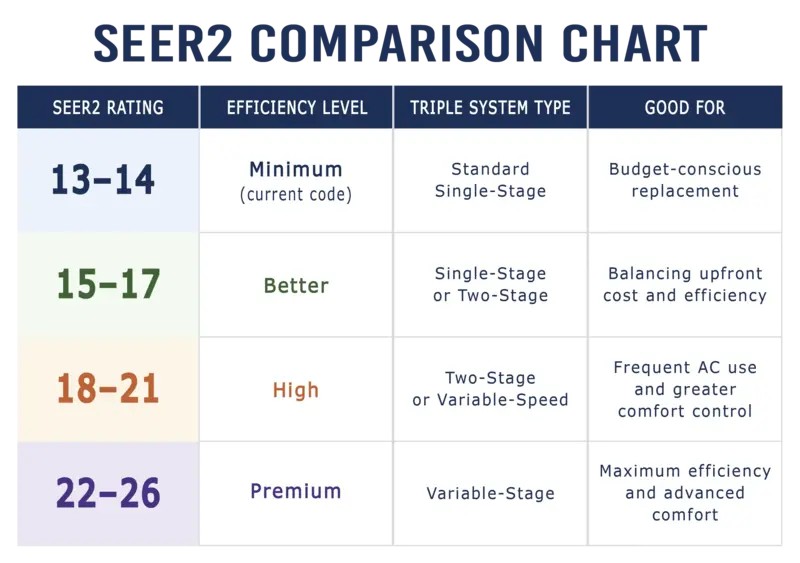
SEER2 is important, but it’s still only one piece of the puzzle. A higher number doesn’t automatically make one system a better fit for your home.
What SEER2 Rating Makes Sens for East Texas Summers?
Texas falls within the Department of Energy’s Southeast region for HVAC efficiency standards.
For split-system air conditioners, the current minimum is 14.3 SEER2 for systems with a cooling capacity below 45,000 BTU per hour and 13.8 SEER2 for systems rated at 45,000 BTU per hour or greater.
Of course, meeting the minimum and choosing the best system for your home aren’t necessarily the same thing.
East Texas summers are long and hot, and our air conditioners put in a lot of hours. Cooling season can stretch well outside the traditional summer months, with plenty of warmer days in spring and fall too.
If your AC runs heavily for much of the year, it may make sense to look at something in the 15–17 SEER2 range or higher. How far you go really comes down to your home, budget, comfort preferences and how long you expect to stay there.
Does a Higher SEER2 Rating Actually Save You Money?
Yes, a higher SEER2 rating can lower your cooling costs, but don’t expect a huge change in your total electric bill. For a typical East Texas home replacing an older 14 SEER system, the estimated savings look something like this:
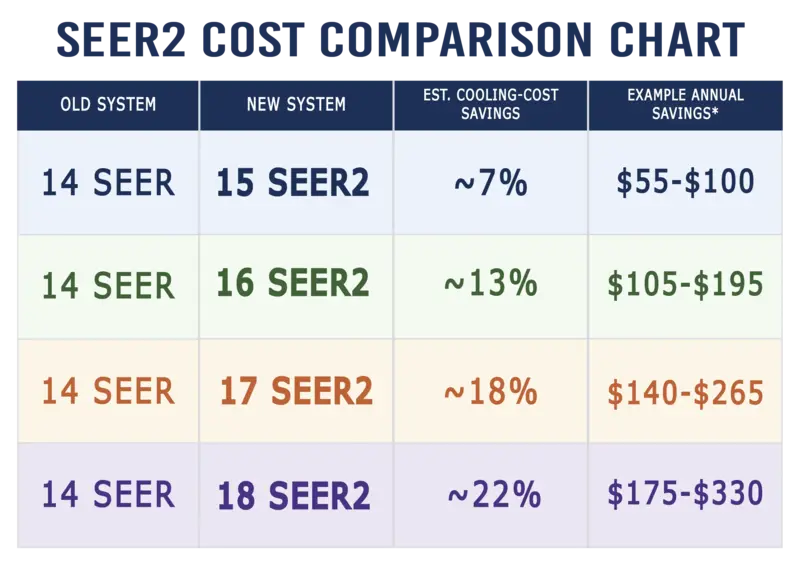
Based on estimated annual cooling costs of $800–$1,500. Actual savings vary depending on your home and how you use your system.
One important distinction: these are savings on cooling costs, not your entire electric bill. Higher-efficiency systems can also cost more upfront, so upgrading isn’t necessarily about getting that money back as quickly as possible.
There are some other benefits that may matter just as much. Higher-efficiency equipment can offer more consistent temperatures, better humidity control and quieter operation. And if your AC is already getting older, replacing it before it breaks lets you make that decision on your timeline, rather than scrambling when it quits during an East Texas summer.
Trane, Daikin & Lennox SEER2 Ratings at a Glance
ETR works with several HVAC brands with options at different efficiency levels and price points. Ratings can vary depending on the exact equipment combination, so be sure to check the specifications for the complete system you’re considering.
Trane
Trane offers everything from basic single-stage air conditioners to high-efficiency variable-speed systems. Current models include:
- 14 Single-Stage: up to 14.3 SEER2
- 16 Single-Stage: up to 17 SEER2
- 17 Multi-Speed: up to 18 SEER2
- 18 TruComfort Variable Speed: up to 18.1 SEER2
- TruComfort 20 Variable Speed: up to 24 SEER2
Daikin
Daikin has single-stage, two-stage and variable-speed options, with central air conditioners ranging from around 14.5 SEER2 into the 20+ SEER2 range.
Examples include:
- DX3SE: up to 14.5 SEER2
- DX4SE: up to 15.2 SEER2
- DX7TC: up to 17.2 SEER2
- DX9VC: up to 22.5 SEER2
Lennox
Lennox offers several efficiency levels across its residential lineup too. For example, the two-stage Merit Series ML17KC2 can reach up to 17.9 SEER2, with other options available depending on the efficiency, comfort features and price point you’re looking for.
And again, don’t get too hung up on finding the highest number. Compressor type, system sizing, humidity control, existing ductwork and the quality of the installation all play a role in how your AC actually performs.
Frequently Asked Questions About SEER Ratings
What is SEER2?
SEER2 stands for Seasonal Energy Efficiency Ratio 2. It’s the current rating used to measure the cooling efficiency of central air conditioners and heat pumps.
What is the difference between SEER and SEER2?
They both measure cooling efficiency, but SEER2 uses a newer, stricter testing procedure that more closely represents the conditions HVAC equipment deals with once it’s installed in a home.
Is a higher SEER2 rating always better?
Not necessarily. A higher number means better energy efficiency, but that doesn’t automatically make it the best system for your home. Cost, cooling needs and the system itself matter too.
Do I have to replace my AC because of the SEER2 change?
No. If your existing air conditioner is still working properly, the SEER2 change doesn’t mean you have to replace it. The standards apply to newer equipment and what can be installed under current efficiency requirements.
What SEER2 rating is required in Texas?
Texas is part of the Department of Energy’s Southeast region. Split-system air conditioners below 45,000 BTU per hour must meet a minimum of 14.3 SEER2, while systems at 45,000 BTU per hour or greater have a minimum requirement of 13.8 SEER2.
Find the Right SEER2 Rating for Your East Texas Home
SEER2 gives you a useful way to compare the energy efficiency of different HVAC systems, but you don’t have to figure out the numbers on your own.
The right system depends on more than the rating printed on the equipment. The size and layout of your home, your existing HVAC system and ductwork, your budget and even your family’s comfort preferences can all make a difference.
If you’re considering replacing your air conditioner, talk with the team at ETR. We can help you compare SEER2 ratings, system options and efficiency levels to find an AC system that makes sense for your East Texas home.